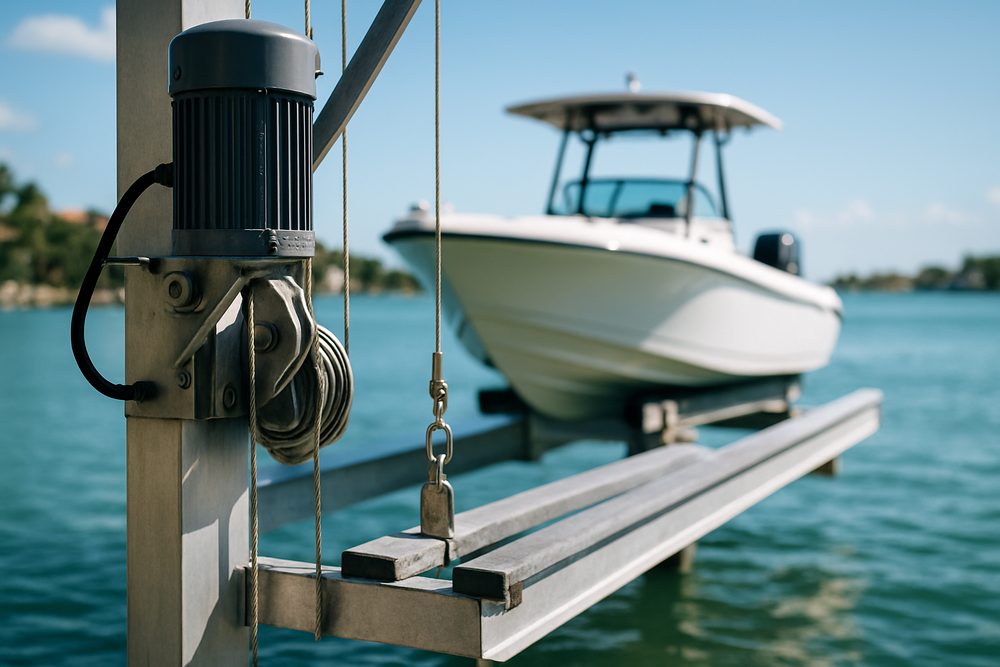
Boat lifts are one of the hardest-working pieces of equipment on any Sarasota waterfront property. They cycle up and down in salt air, sit partially submerged through tidal swings, and absorb UV radiation year-round. When a lift starts groaning, moving unevenly, or refusing to hold position, it is not a minor inconvenience - it is a warning that your boat could end up sitting in saltwater instead of above it.
## Why Boat Lifts Fail Faster in Coastal Sarasota County
The Sarasota Bay system, including Little Sarasota Bay, Roberts Bay, and the backcountry canals of Osprey, Nokomis, and Venice, presents a specific set of conditions that accelerate wear on boat lift components. Salinity levels in these shallow, semi-enclosed bays are consistently high because tidal flushing is moderate and evaporation in the Florida heat concentrates salt in the water column. That means every metal component on a lift - cables, drums, pulleys, motor housings, gearbox shafts, and hardware - is under constant corrosive attack.
Summer heat compounds the problem. UV exposure breaks down bunk carpet, PVC wrap on bunks, and the rubber seals inside motor and gearbox assemblies. Afternoon thunderstorms drive moisture into electrical connections. In winter, manatee activity and boat traffic in shallow bay areas can put unexpected side-loads on lift legs and crossbeams. These are not national averages - this is what we see on the water here every week.
## Common Boat Lift Repairs We Handle
**Cable replacement** is the most frequent repair call we get. Lift cables are under substantial tension every time the lift operates, and salt water wicks up stranded wire, corroding from the inside out. By the time you see fraying or rust weeping at the drum, the internal core strands may already be compromised. We replace cables with correctly rated stainless or galvanized wire rope, re-rig the entire cable path, and inspect pulleys and sheaves for flat spots or cracking before the new cable goes on. Installing a new cable on a worn pulley just transfers the problem.
**Motor and gearbox service** is the second most common issue. Electric lift motors are exposed to spray and humidity, and the gearboxes that translate motor speed into lifting torque take a beating when cables are misaligned or the load is off-center. Symptoms include slow operation, grinding or clicking sounds, a motor that runs but produces no movement, or a breaker that trips repeatedly. We diagnose whether the fault is in the motor windings, the capacitor, the gearbox internals, or the mounting and alignment. Many motors can be rebuilt or replaced without touching the rest of the lift structure.
**Bunk replacement and adjustment** is essential to hull protection. Bunks that are rotted, waterlogged, or set at the wrong angle for your hull will cause pressure points, gelcoat stress, or allow the boat to shift during lifting. We recarpet or replace bunk boards using exterior-grade treated lumber, re-position bunk arms to match the hull lines of the vessel that actually uses the lift, and check that the cradle distributes weight evenly across the keel and strakes.
**Structural repairs** cover bent or corroded legs, broken crossbeams, failed weld joints, and deteriorated through-bolts at the dock connection points. A lift that wobbles or tilts under load is a lift that is failing structurally, and no amount of cable or motor work will fix a frame problem.
## New Boat Lift Installation - Sizing Matters
If a lift is beyond economical repair, or if you are installing on a new dock or upgrading to a larger vessel, correct sizing is the single most important decision in the whole project. Undersizing a lift is dangerous. Oversizing wastes money and can overload a dock structure not designed for the extra dead weight.
We size new lifts based on your boat's fully loaded displacement - fuel, water, gear, and engine - not the dry hull weight listed on the spec sheet. For most bay and inshore vessels in Sarasota County, that means accounting for a 10 to 20 percent buffer above the stated boat weight to cover real-world loading. We also factor in the water depth at the installation point, tidal range, the available dock footprint, and whether the lift needs to accommodate a T-top, outriggers, or hard top that affects the lift height envelope.
Lift types we install include freestanding four-post lifts for open dock ends, two-post cantilever lifts for tight slips, and floating drive-on options where water depth and tidal variation make a traditional lift impractical. Each type has trade-offs in cost, ease of use, and maintenance burden, and we walk through those trade-offs honestly with you before any deposit changes hands. [Request a quote](/contact) and we can assess your specific slip and vessel combination before recommending a lift type.
## The Installation Process from Start to Finish
A new boat lift installation with Sarasota Dock Repair follows a consistent sequence. We start with a site visit to measure water depth at the installation point across the tidal cycle, assess the dock structure for load capacity, and confirm permit requirements with the applicable county or municipality. Sarasota County and the City of Venice have specific setback and size thresholds for boat lift permits, and we handle the application process rather than leaving it on your plate.
Once permits are cleared, lift components are staged on the dock. For four-post lifts, we set the legs to the measured depth, square the frame, and confirm level before any crossbeams or bunks are attached. The motor and gearbox assembly is mounted, wired to a dedicated circuit at the dock power panel (a licensed electrician handles the panel work), and tested through several full travel cycles before we consider the job complete. Bunk positions are set to the customer's vessel and verified with the boat loaded on the lift and the lift raised to operating height.
For cable repairs and motor replacements on existing lifts, most jobs are completed in a single visit. We carry a working inventory of common cable sizes, motors, and gearbox assemblies on the truck, so we are not leaving your lift down while we wait on parts.
## Mistakes to Avoid with Boat Lift Maintenance
The most common and costly mistake is ignoring slow or uneven operation. Owners frequently live with a lift that takes longer than it used to, operates with a grinding noise, or raises unevenly side-to-side. Each of those symptoms points to a problem that gets worse - and more expensive - the longer it runs. A cable that is fraying should cost a fraction of what a dropped boat or a blown gearbox costs.
The second mistake is performing partial repairs without inspecting the whole system. Replacing one cable without checking the opposing cable's condition, or rebuilding a motor without looking at the drum alignment, is a short-term fix that sets up the next failure. We inspect the full cable path, all hardware, the motor mount, and the structural frame any time we are on a lift for any repair, and we tell you honestly what we find.
Third: using the wrong lubricants. Many boat lift manufacturers specify a particular grease type for gearboxes and cable drums. Owners often substitute whatever is on the shelf. Incompatible lubricants can break down seals or fail to protect under the load cycles a lift gearbox sees. We use the specified lubricant for each component and note it on the service record we leave with you.
## Repair vs. Replace - How to Decide
A lift that is structurally sound, correctly sized for the current vessel, and showing only component-level wear - cables, motor, bunks - is almost always worth repairing. A lift that is undersized for a new boat, has a corroded or bent frame, is built on a discontinued platform where parts are no longer available, or has had repeated failures in the same systems is a candidate for replacement. We give you a straight cost comparison: repair estimate vs. new installation estimate, and we do not steer you toward a new lift if repair makes economic sense.
For customers who are on the fence, [our FAQ page](/faq) covers the most common questions about repair versus replacement decisions in more detail.
## Timing - When to Book, When It's Urgent
Non-emergency repairs - bunk recarpeting, preventive cable replacement before visible wear, motor lubrication service - should be scheduled in the off-peak window between November and February, when our lead times are shorter and you are less likely to need the lift daily. If a cable has visible fraying, a motor is failing mid-cycle, or a structural component is visibly bent or cracked, treat it as urgent. A lift in that condition should not be used until it is repaired, and we prioritize those calls accordingly.
Permit timelines for new installations vary. Sarasota County can run four to eight weeks for a boat lift permit depending on current workload and whether environmental review is required for the specific location. Plan new installations well ahead of the spring boating season if you want to be in the water on time.
## Keeping Your Lift in Good Shape After Service
Rinse the motor housing, cable drums, and pulleys with fresh water after any significant saltwater splash or submersion - especially after storms. Operate the lift through its full travel range at least once a week, even when the boat is not moving. Stationary cables and drums that sit in one position develop corrosion at the contact points faster than components that cycle regularly.
Inspect the cable ends at the drum anchor and at the hook or cradle connection quarterly. These are the highest-stress points and the first place fatigue shows up. Replace bunk carpet before it wears through to the wood, because bare wood against gelcoat causes damage in one or two tidal cycles. And have the gearbox oil or grease checked annually - most manufacturers recommend a drain-and-refill on the gearbox every two to three years under normal use.
Sarasota Dock Repair offers annual service agreements that cover a full lift inspection, cable lubrication, bunk check, and motor test on a scheduled basis, so the lift stays ahead of problems rather than reacting to them. We serve marinas, private residences, and commercial properties throughout Coastal Sarasota County - from Siesta Key and Casey Key to Osprey, Nokomis, and Venice. See the full list of [areas we serve](/locations) to confirm we cover your waterfront.