## Why Sarasota Docks Deteriorate Faster Than You Expect
Coastal Sarasota County puts docks under constant stress that landlocked property owners rarely anticipate. Salt air accelerates corrosion in fasteners and hardware. Tidal fluctuation along Sarasota Bay, Little Sarasota Bay, and the intercoastal channels means dock framing cycles between wet and dry dozens of times each week. Marine borers - primarily *Limnoria* and *Teredo navalis* - are active in these warm, brackish waters year-round, and they can hollow the interior of an untreated timber piling while leaving the surface looking almost intact. Add seasonal thunderstorms, the occasional tropical system, and the persistent UV that bakes unprotected wood surfaces, and even a well-built dock begins showing real wear inside of a decade.
Understanding those drivers is the starting point for every repair or rebuild estimate we write. A fastener swap will not save a dock when the stringers underneath are punky with rot. Replacing the decking will not stop movement if three pilings have been bored hollow. Good dock work begins by diagnosing the actual problem, not just the visible symptom.
## Decking Replacement - The Most Common Repair
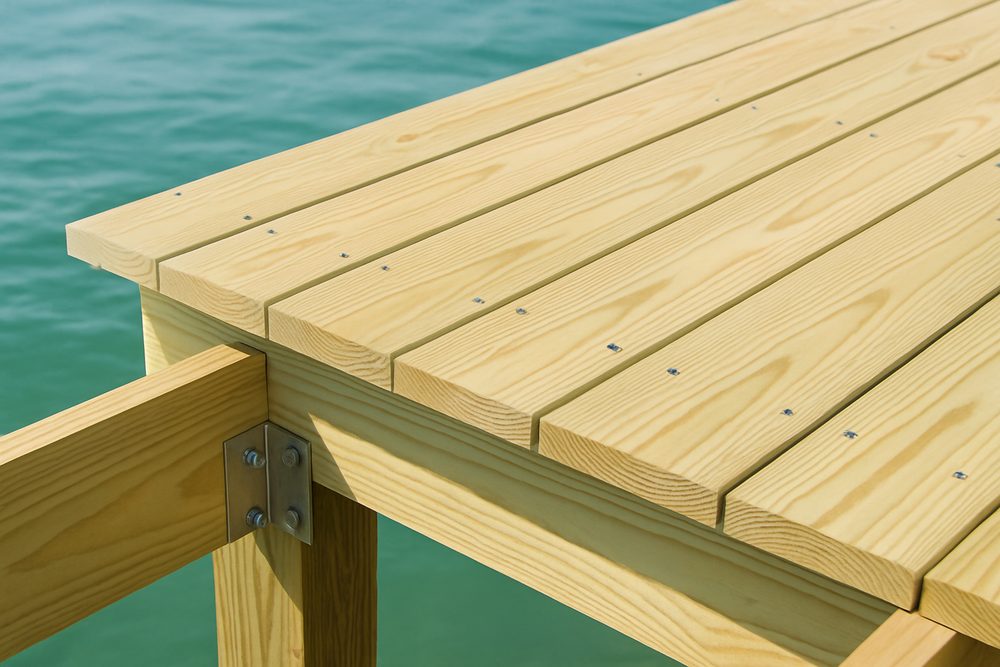
Deck boards are the most frequently replaced component because they take the most direct abuse: foot traffic, UV, rain, and saltwater dripping from wet lines and anchor rodes. In Sarasota County the deck surface also runs hot - bare pressure-treated pine on a July afternoon can reach temperatures that are uncomfortable to walk on barefoot and that accelerate wood breakdown over time.
We most often replace decking with five-quarter-by-six pressure-treated southern yellow pine (rated for ground contact and treated to UC4B or UC4C standards for marine splash zones), tropical hardwoods like Ipe or Garapa, or composite decking products rated for marine environments. Each material has tradeoffs. Composite resists rot and splinters but costs more upfront and can feel soft underfoot on long spans. Ipe is extremely durable but heavier and harder to fasten correctly. Pressure-treated pine is cost-effective, familiar to code inspectors, and easy to source locally, but it needs periodic cleaning and sealing to perform well.
Regardless of material, we pull the old decking completely rather than decking over it. Leaving old boards in place traps moisture against the stringers below, which is one of the fastest ways to destroy a structurally sound frame. While the deck surface is off, we probe every stringer, check fastener pullout resistance, and look for any early-stage stringer rot that would be invisible once new boards are down.
## Stringers, Framing, and the Hidden Cost of Deferred Maintenance
Stringers - the longitudinal members that span piling to piling and carry the deck load - are where deferred maintenance costs compound the most. Because they sit just above the waterline and are covered by the deck above, stringer rot can progress for years without any sign visible from the dock surface. The first symptom a homeowner usually notices is a soft spot underfoot or a deck board that flexes more than the ones around it.
By the time softness is noticeable underfoot, stringer damage is usually significant. We have opened decks in Osprey and Nokomis neighborhoods where the outer face of the stringer looked solid but the interior had been reduced to fiber by moisture and fungal decay. At that stage a sister stringer can sometimes be bolted alongside the original, but more often the damaged member needs to come out entirely.
Framing repairs extend to rim boards, cross-bracing, and the ledger connection where the dock ties to a seawall cap or upland structure. The ledger is a frequent failure point because it traps water against the connection surface. We use stainless-steel or hot-dipped galvanized hardware throughout - never zinc-plated, which rusts within a couple of seasons in a salt environment.
## Piling Assessment and Replacement
Pilings are the foundation of the entire structure, and their condition determines whether a repair is worth doing at all. In Sarasota's estuarine waters, timber pilings are attacked from below by boring organisms and from the splash zone - roughly the 18 inches above and below mean water line - by rot-causing fungi that thrive where the wood is intermittently wet.
We assess pilings by visual inspection, by sounding (tapping with a hammer and listening for hollow tone), and by probing with a pick or awl at the splash zone. We also look at the pile cap connection and any existing wrap or sleeve that may be hiding damage underneath. Wrapped pilings that were installed correctly and maintained can last significantly longer, but we have also seen wraps that concealed advanced deterioration.
When a piling is compromised, the options are full extraction and replacement, or sistering a new piling alongside and transferring load to it. Full replacement is cleaner structurally but requires driving or jetting a new piling and involves permitting in most cases. Sistering is faster and sometimes avoidable of a permit for minor work, but it adds mass to the structure and is not always feasible in tight dock configurations.
We use CCA-treated timber pilings or composite fiberglass pilings depending on the site and customer preference. Composite pilings are immune to borers and rot but carry a higher material cost. For customers who have had repeated piling failures in a heavily infested area, the lifecycle math often favors composite.
## The Full Storm Rebuild Process
After a significant tropical weather event, some docks arrive at a point where component-by-component repair is no longer the right answer. If more than roughly half the framing members are compromised, if the piling layout was inadequate before the storm and damage has exposed that fact, or if the dock footprint needs to change to meet current code, a full rebuild is the cleaner and usually more cost-effective long-term path.
A full rebuild with us follows this sequence: site assessment and photo documentation, permit application to Sarasota County or the relevant municipality (most dock work over a certain threshold requires a right-of-way or over-water permit, and we handle that paperwork), demolition and debris removal, piling installation, framing, decking, hardware and accessory installation, and final inspection. We coordinate with the county inspector directly, so the homeowner does not need to manage that process.
Permit timelines in Sarasota County vary. Straightforward replacements in-kind on an existing permitted footprint often move faster than new footprint work or projects that require environmental review through Southwest Florida Water Management District. We build realistic timelines and communicate them clearly before work starts rather than promising a date we cannot keep.
If you are planning a rebuild after storm damage, [request a quote](/contact) early - permitting lead times are longest immediately after a named storm when every dock contractor in the county is filing simultaneously.
## Repair vs. Replace - How We Make the Call
The honest answer to "should I repair or replace?" depends on three things: the percentage of structural members that are compromised, the age of the structure, and what the customer wants the dock to do going forward.
As a general rule, if the pilings are sound and fewer than a third of the framing members need replacement, targeted repair is almost always the right call. If the pilings are failing or the framing damage is widespread, the labor cost of piecemeal repair often approaches or exceeds the cost of a rebuild - and the rebuild gives you a fresh 20-to-30-year baseline rather than a patched structure of uncertain remaining life.
We will tell you when a repair does not make economic sense, even when the simpler sale would be to take the repair job. A customer who gets honest advice comes back and sends their neighbors.
For common questions about how we scope and price both repairs and rebuilds, visit our [common questions](/faq) page.
## Common Mistakes and How We Avoid Them
The most damaging mistake in dock repair is treating visible damage as the full scope of work. A crew that replaces only the boards a customer points to, without probing stringers or sounding pilings, is setting up a callback in 18 months when the hidden rot progresses.
The second most common mistake is using the wrong fasteners. Standard galvanized screws or bolts will rust through in two to three years in a saltwater splash zone. We use Type 316 stainless-steel structural screws and bolts, or hot-dipped galvanized at minimum. The cost difference between correct and incorrect fasteners on a typical deck job is small relative to the total project cost; the performance difference is enormous.
Third is inadequate piling depth. Sarasota's bay bottom varies from soft muck in protected coves to firmer sand and shell in higher-energy areas. Pilings driven to refusal or jetted to proper embedment depth - typically a minimum of one-third of total piling length in the ground - are the difference between a dock that moves in a storm and one that holds. We do not cut corners on embedment because the customer feels it in the next hurricane season.
## Keeping Your Dock in Shape After Repair
A repaired or rebuilt dock requires less maintenance than most homeowners expect, but not zero. Pressure-treated wood decking benefits from an annual wash with a diluted oxygen bleach solution to remove salt deposits and mildew, followed by a penetrating wood sealer. Keep the deck surface clear of leaves and organic debris that hold moisture and accelerate surface decay.
Inspect fasteners and hardware annually - look for rust staining around screw heads, which indicates the fastener is corroding even if the wood looks fine. Check piling wrap or sleeve edges for lifting, which allows water intrusion. After any named storm, walk the dock before putting weight on it and look for piling movement, framing separation at connections, or deck boards that have shifted.
Catching problems at the first sign keeps repair costs proportional. A single rotted stringer caught early is a half-day job. The same stringer ignored for two more seasons may take framing and decking down with it.
We serve property owners across Coastal Sarasota County, from Siesta Key and Osprey to Nokomis, Venice, and Englewood. See the full list on our [areas we serve](/locations) page. Whether the job is two deck boards or a complete post-storm rebuild, the process starts the same way: an honest look at what is actually happening to your structure and a straight answer about what it will take to fix it right.